
Choose earrings for a round face by mapping length, cheek clearance, the jaw endpoint, and where the visual weight lands. Open the detector
earrings for round face
For earrings for round face, start with a four-line fit map: compare the earring's visible length with its width, note where the broadest point stops at the cheekbone, compare the lower edge with the jaw, and decide where the visual weight lands. A slim drop or narrow elongated hoop that travels below the jaw usually creates a clearer vertical route than a wide circular pair, but the best choice is the one that keeps that route while you move, turn, and wear your hair in its usual direction.
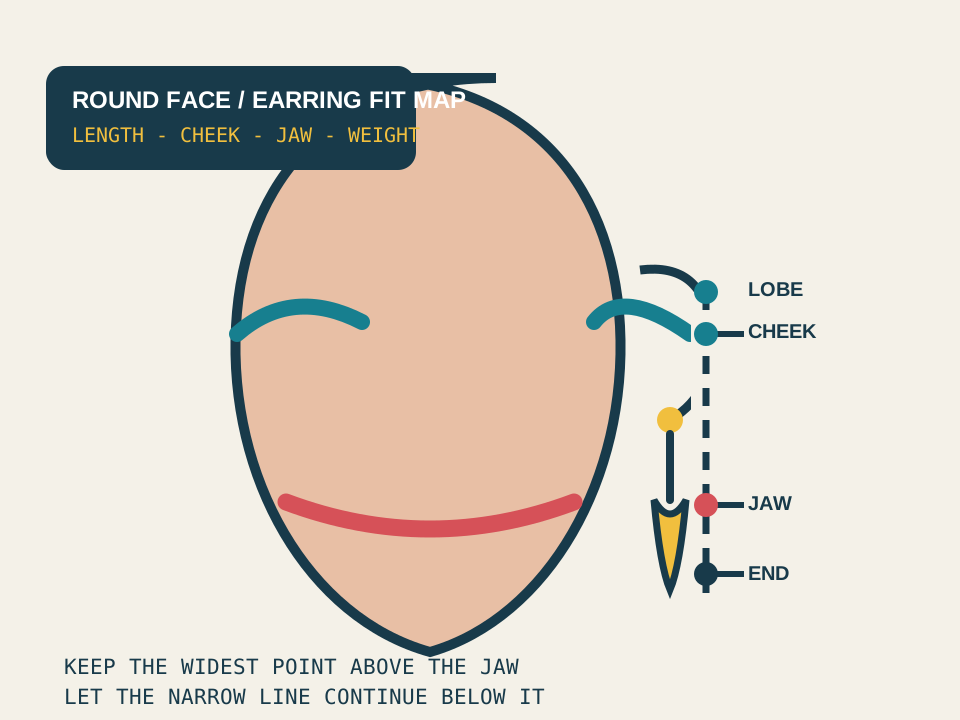
Build a four-line earring fit map
You do not need to relabel your face to choose earrings. Stand in even daylight with the hair away from the ears and take one front photo and one three-quarter photo on each side. Use the photos only to mark four landmarks: the lowest point of the earlobe, the fullest part of the cheek, the lower edge of the jaw, and the point on the neck where the earring ends.
The four landmarks turn vague advice such as "choose long earrings" into a repeatable check. A pair can look long on a product page but become a small circle beside the cheek when worn. Another pair can look simple in the box but create a clean vertical line because its lower section stays narrow. Judge the silhouette from lobe to end, not the name in the listing. Use the [face-shape reading guide](/what-is-my-face-shape) only if the round label is still uncertain; earring fit does not depend on a perfect label.
Take both photos before trying jewelry. Hair, a high neckline, and the angle of the camera can change the apparent lower-face outline more than a few millimeters of earring length. The purpose of the map is consistency: the same lobe-to-jaw distance should guide every pair you compare.
Measure the visible silhouette, not the product name
An earring's length-to-width ratio is more useful than a category such as drop, dangle, or bar. Imagine a rectangle around the part that hangs below the ear. A pair around 25 mm long and 9 mm wide has a visible ratio near 2.8 to 1, which usually reads as a vertical line. A broad fan 20 mm wide may read horizontal even if its total length is greater.
Use a ruler on a pair you already own:
- Measure from the bottom of the hook or stud setting to the lowest point.
- Measure across the widest visible part, not only the narrow connector.
- Measure the hoop on its long axis, then compare its wire thickness.
- Repeat with the earring in front of the cheek, because perspective can shorten a still-life measurement.
A 4 x 4 mm stud is compact in both directions; it can look clean, but it adds little downward direction. A 20 x 16 mm oblong hoop is still relatively compact, while a very thin 20 x 32 mm hoop begins to draw a longer line. These examples are comparison tools, not size rules. Scale matters: the same earring will occupy a different share of the face on different people.
Set the cheek-window stop
The cheek window is the space between the earring's widest point and the fullest part of the cheek. A horizontal fan, clustered charm, or open round hoop placed directly beside that fullness repeats the roundest visible line. A narrow section or a vertical bar leaves more air there and allows the eye to travel downward instead of across.
This does not mean every earring must be thin. A wider top can work when the lower part becomes narrow, because the weight is held high and the route continues. The awkward result is usually the opposite: a quiet top followed by a wide, long cluster at the jaw. Check the side view too. If the earring disappears from the front but looks heavy in profile, it may still feel visually bottom-loaded.
For a slimmer route, start with one of these structures:
- Linear drop: a narrow bar, chain, or open frame that continues below the lobe.
- Threader: a fine line that crosses the lower ear and exits below it.
- Marquise or pear form: an elongated stud whose point carries the eye down.
- Soft geometric drop: a rectangle, diamond, or tapered form with a quiet center.
- Elongated hoop: an oval or narrow oval with enough open space to avoid becoming a disk.
Let the jaw exit do the real work
Mark the jaw in the front photo, then hold a candidate earring beside the ear. Its lower edge can sit above the jaw, meet it, or pass it. Using the bottom of the lobe as zero gives a practical length ledger:
| Drop below the lobe | Visual effect | Best use |
|---|---|---|
| 0-1 cm | Minimal direction; reads much like a stud | Everyday when the earring itself is the main accent |
| 1-3 cm | Mild guidance; useful when the cheek is already open | Workdays, minimal outfits, sensitive ears |
| 3-5 cm | Clear vertical route without reaching the shoulder | The most flexible everyday test band |
| 5-8 cm | Strong line and more occasion weight | Dresses, bare necklines, evenings |
| More than 8 cm | Dramatic line where the whole neck becomes part of the look | Deliberate styling, not an automatic improvement |
The exact band should follow the length of your lower face, not a universal centimeter target. The useful question is whether the lower edge merely circles the cheek or continues beyond the jaw. When two pairs have the same drop, choose the narrower one if the goal is a cleaner downward route. When both are narrow, choose the pair whose endpoint feels intentional with your usual neckline.
A pair that stops at the cheek can still work if its mass is compact and close to the lobe. A pair that ends below the jaw can still feel heavy if a wide pendant flares at its lowest point. Compare endpoint and width together. See the [round-face hairstyle guide](/hairstyles-for-round-face-shape) if you want to change the outline around the cheek with hair before buying another pair.
Decide where the weight is allowed to land
Picture three points on each earring: the attachment, the middle, and the lowest visible feature. The largest or brightest feature will attract the eye to that level. High weight creates a lift near the lobe. Even weight supports a steady line. Bottom weight creates a new horizontal event at the jaw or neck.
For a balanced round-face look, use high weight with a thin continuation, or keep the mass evenly narrow from top to bottom. A slender teardrop with a small lower point belongs to the first group. A tapered bar belongs to the second. A broad chandelier with a wide lower fan is a deliberate choice, but it will add more jaw-level emphasis than a simple drop of the same length.
Do not confuse physical weight with visual weight. A light but very wide acrylic hoop can look more dominant than a heavier narrow metal drop. Comfort still matters: a margin of safety for stretched piercings, a hook that stays closed, and a total mass you can wear for several hours are non-negotiable fit checks.
Test circles by wire, diameter, and direction
Round does not mean that every circular earring is off-limits. A thin oval hoop can trace a longer outline, especially when its long axis is vertical and its widest section sits away from the fullest cheek. A thick round hoop creates a stronger horizontal ring. A small round hoop can work like a compact stud when visual quiet is the goal.
Use three comparisons instead of banning a shape:
- Keep the diameter the same and compare thin wire with thick wire.
- Keep the wire the same and compare a circle with a vertical oval.
- Wear each pair with the hair up, then with the hair down.
If the hoop makes the middle of the face feel busier, reduce thickness before reducing diameter. If it still competes with the cheek, change to a narrower oval or a linear drop. If the circle feels balanced, keep it; the goal is control of the visual route, not obedience to a geometric rule.
Coordinate the earring with hair, glasses, and neckline
Hair and frames already create lines around the face. A tucked style exposes the full earring and makes length easy to judge. Hair worn forward can cover the upper half, leaving only the lowest feature visible, so a bottom-heavy pair may become even more dominant. Glasses add a horizontal line across the upper face; compare their lower rim with the earring's first vertical section so the two do not make a crowded cluster at the cheek. The [round-face glasses guide](/glasses-for-round-face-shape) is useful when both accessories stay on at the same time.
The neckline is the third line. A high crew neck and a long shoulder-grazing earring compete for the same narrow gap. A V neckline, open collar, or strapless line gives a longer drop room to breathe. You do not need to change clothes to make an earring work, but photograph the combination you actually plan to wear. If you are building the whole styling map, compare the [round-face makeup guide](/makeup-for-round-face) after the earring line is settled rather than changing earrings and makeup at the same time.
Run a seven-minute real-world trial
- Put the hair in its normal part and wear the neckline you expect to use.
- Photograph the front view before touching the earring.
- Turn to each three-quarter view and notice where the longest line points.
- Smile, speak, and tilt the head to check movement and snagging.
- Put on glasses or a hat if either belongs in the outfit.
- Sit for two minutes to judge whether the closure and total weight remain comfortable.
- Keep only two photos: the pair that creates the clearest route and the closest alternative.
This short trial reveals problems a mirror cannot show. A hook may rotate forward, a wide charm may catch hair, or a close backing may press against the lobe. Those fit failures matter even when the shape looks right. Treat comfort as part of the design, not a separate concern.
Repair a pair that is almost right
You can often adjust the styling around an earring before replacing it. Move hair behind the ear so the upper structure is visible, choose a more open neckline, or separate the earring from glasses by changing the glasses' lower rim. Swap a wide bottom charm for a narrow one if the jewelry is modular. If the earring itself feels too round, angle an oval hoop slightly toward vertical and check the new outline in a photo.
Do not bend a plated wire, force a thick post through a small piercing, or carry a heavy design on a damaged hook. Those are repair boundaries rather than styling options. If the closure opens during the trial, the pair is not ready to wear outside regardless of its silhouette.
Questions about earrings for round face
Are small studs useless on a round face?
No. A compact stud can be an excellent quiet choice, especially when the hair, glasses, or neckline already carries enough direction. The limitation is only that it adds little length on its own. Use a vertically oriented marquise, pear, or narrow bar when you want a small footprint with a slightly stronger line.
What earring length is most useful for a round face?
Start with the 3-5 cm band below the lobe when you want a clear everyday route. Compare a shorter pair for minimal styling and a 5-8 cm pair for a stronger evening line. The endpoint relative to the jaw matters more than the number on the product listing.
Can thick round hoops work on a round face?
They can, but they create a stronger horizontal ring than thin ovals. Try a smaller diameter, thinner wire, or a vertical oval first. Keep the thick circle if it suits the outfit and remains comfortable; the rule is about controlling emphasis, not banning circles.
Should earrings match a round-face hairstyle?
They should coordinate rather than match. Hair up exposes the whole earring and lengthens the visible route. Hair down can hide the top and make the bottom feature more important. Test the actual hairstyle you wear most often so the earring doesn't look balanced only in a salon mirror.
How can I test earrings without buying them?
Tape a paper cutout of the measured silhouette beside the ear, photograph the front and three-quarter views, and compare it with a pair you already own. Then try the closest real pair for comfort, closure, movement, and hair snagging. Measurements narrow the shortlist; the physical trial makes the decision.
The dependable earring is not simply long or angular. It gives the eye a controlled exit from the roundest cheek, leaves useful breathing room, and lands its visual weight where you intended. Once those four lines are clear, the shopping decision becomes much smaller.