
Separate surface color from undertone with neutral drapes, controlled light, and a repeatable comparison ledger. Open the detector
skin tone analysis
For skin tone analysis, separate surface color from undertone before naming a warm, cool, neutral, or olive direction. Surface color is what you can see in a particular light: redness, tan, ash, gold, or shadow. Undertone is the more consistent color relationship you infer by comparing neutral drapes in controlled light. Neither observation diagnoses health, ancestry, or a foundation shade by itself.
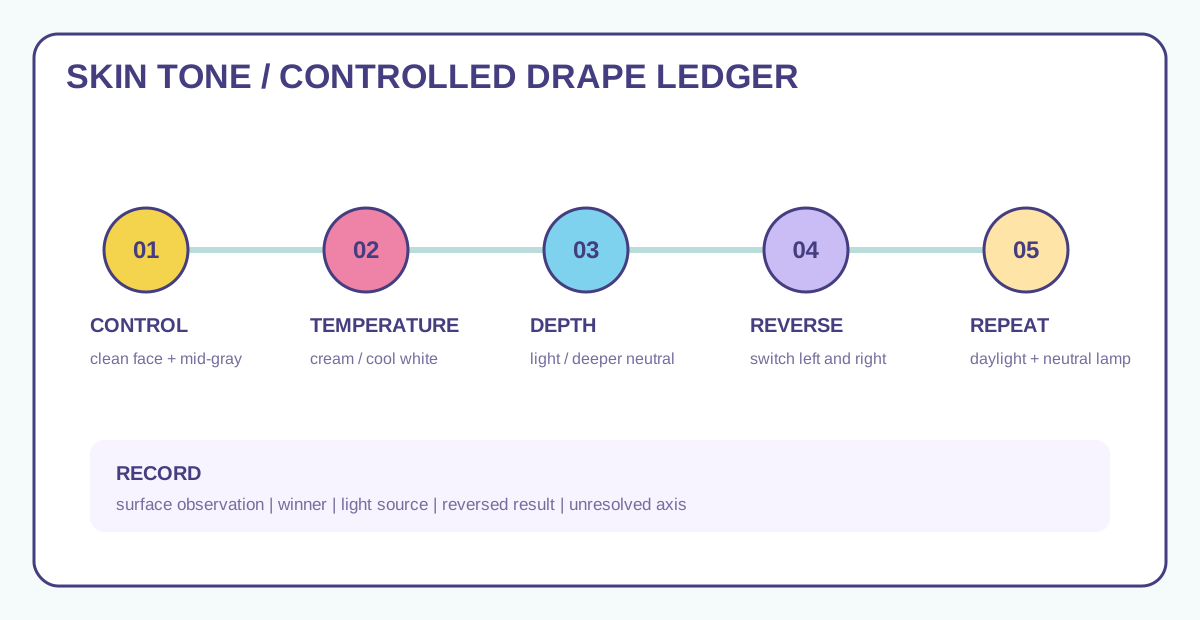
Start with a neutral control
Cleanse the face and wait for any temporary redness from washing to settle. Remove colored clothing from the area around the neck, tie hair away from the face, and use a white or mid-gray towel as a control. Stand beside indirect daylight, avoiding direct sun and colored walls. If the room has a strong warm lamp, turn it off for the comparison.
Take a reference photo without a beauty filter. Keep the camera at eye level and prevent the background from changing between images. The first photo is not the analysis; it is a record of the conditions. Without that record, it is impossible to tell whether a difference came from the skin or the room.
Read surface color first
Surface color is allowed to vary. It may include:
- visible redness around the nose or cheeks;
- a tan or sun-exposed area;
- shadows under the eyes;
- temporary flushing after exercise;
- cosmetic color remaining on the skin.
Write those observations as surface notes, not as undertone conclusions. A red patch does not by itself make the skin cool. A golden tan does not by itself make the undertone warm. The skin can change while the underlying comparison relationship stays similar, and the reverse can also happen when lighting or camera processing changes.
Compare undertone with paired neutral drapes
Use fabrics that are close in value so brightness does not decide the winner for you. Plain white and cream make one temperature pair. Cool gray and warm taupe make a second. A blue-leaning rose and a warm coral can be a third if the first two pairs are close.
Hold each pair under the chin, then beside the cheek, then slightly below the jaw. Reverse the order and check again. Do not ask which fabric is prettier. Ask which one leaves the face looking more even at the center, around the nose, and along the jaw.
A useful observation sounds specific: "Cool gray made the area under the eyes look less shadowed than taupe," or "Cream made the redness around the nose less obvious than white." A vague statement such as "gold is my color" does not tell you whether value, chroma, or temperature caused the result.
Do not turn veins into proof
Vein color can be affected by light, skin thickness, camera color processing, and the surrounding fabric. Use it only as a small clue, never as a stand-alone test. The same applies to jewelry. Gold and silver can help you create a pair, but the metal finish, size, reflection, and your preference can influence the judgment.
Instead of asking "do I have blue or green veins?" ask "does the cool version of this neutral repeatedly produce a cleaner comparison than the warm version?" That wording keeps the observation tied to a physical test and makes it possible to repeat.
Check light before changing the answer
Color perception depends on the light spectrum, the size and shape of the stimulus, the surrounding color, and the observer's adaptation. A change from window light to tungsten light can therefore change a fabric without changing the skin. The practical response is not to search for one magical light. Test in at least two ordinary conditions and label both.
- Daylight: indirect daylight near a window, no direct sun.
- Neutral indoor: a white-light room without a strongly colored wall.
- Evening: the light you actually use at home.
- Camera check: one image with white balance locked if your phone allows it.
If the preferred drape changes with every light, the result is unresolved. If the same broad direction survives daylight and neutral indoor light, it is useful enough for a foundation counter or shopping test.
Separate surface tone and undertone in your notes
A compact ledger prevents the two ideas from collapsing:
| Field | Example of a valid note |
|---|---|
| Surface note | "Visible redness around the nose; no active irritation assumed." |
| Temperature observation | "Cool gray looked more even than warm taupe in daylight." |
| Depth observation | "Light colors separated less than mid-depth colors." |
| Clarity observation | "Bright white dominated; soft white was quieter." |
| Unresolved question | "The pair reversed in evening light." |
Do not write a medical interpretation into this ledger. If there is pain, sudden color change, persistent irritation, or a changing mole, use an appropriate medical resource rather than cosmetic analysis.
What olive can change
Olive is often described as a green or gray-green relationship rather than simply warm or cool. Different people use the word differently, and lighting can make an olive direction look neutral. If warm and cool pairs both fail, try a third pair with neutral-olive and clear-neutral fabrics at the same depth. Keep your finding comparative: "olive-leaning neutral looked more settled than peach or rose" is more useful than insisting on a universal olive formula.
Use the result for a trial, not a verdict
Once one temperature pair and one depth pair are stable, take the result to a foundation counter or use returnable samples. Test along the jaw and neck in daylight. Do not let store lighting choose the shade for you. A cosmetic match can include surface redness, tan, undertone, coverage, and oxidation; skin tone analysis is only one input.
Keep the result provisional after the first session. Repeat it four to seven days later with clean skin and the same control cloth. For the wider color relationship around the face, continue with this site's [color analysis quiz](/color-analysis-quiz). The quiz evaluates temperature, value, chroma, and contrast together; this page isolates surface color and undertone.
For related site work, use the [detector guide](/face-shape-detector-guide) when you want a photo-quality and face-measurement vocabulary, the [face shape chart](/face-shape-chart) when you are measuring proportions, and [makeup for round face](/makeup-for-round-face) or [blush placement](/blush-placement) when placement matters more than shade selection.
Skin tone analysis questions
How can I tell warm and cool undertone?
Compare close-value neutral drapes such as cream and cool white, then warm taupe and cool gray. Repeat the pair in daylight and neutral indoor light. A repeated comparison is more useful than one vein or jewelry observation.
Why does my skin look different in every photo?
Phone white balance, exposure, background color, compression, and the light around the face can all change the result. Use a neutral control, the same camera position, and a note about the light before interpreting the difference.
Can tanning change my undertone?
Tanning changes visible surface color and may make the skin appear lighter or deeper. Treat that as a surface observation and repeat the undertone comparison after the surface color stabilizes. Do not infer a permanent category from one sun-exposed photo.
Is skin tone analysis the same as a color analysis quiz?
No. The quiz compares several color relationships around the face, including temperature, depth, clarity, and contrast. Skin tone analysis focuses first on surface color versus undertone. The two observations can inform each other but should stay separate in your notes.
The best skin tone analysis is a short, repeatable comparison that tells you which question remains unresolved. It should leave you with a provisional direction and a cleaner next test, not a permanent label.