
Run a controlled photo test with a center-line pass, paired-feature check, and repeatable evidence ledger instead of a beauty score. Open the detector
face symmetry test
A face symmetry test compares corresponding features on the left and right sides of the face to identify visible differences in one controlled photograph. It can help you record where a difference appears, whether it repeats, and whether it changes with expression. It cannot measure attractiveness, diagnose the cause of a difference, or prove that any treatment is needed. The result belongs to the photo and conditions you tested, not to your worth or identity.
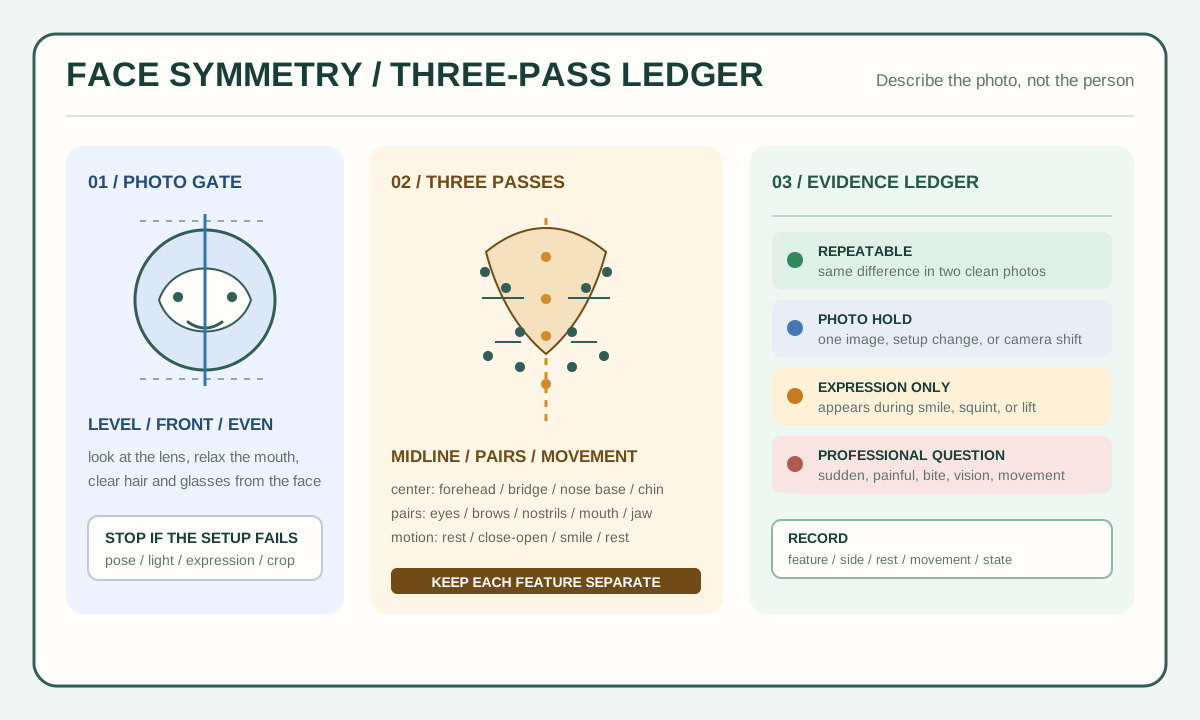
Set the evidence gate before scoring
Begin with a photo that gives the comparison a fair chance. Face the camera directly, look at the lens, keep a neutral expression, and hold the phone or camera at eye level. Use soft, even light from the front instead of a side lamp or direct sun. Tie back hair that crosses the jaw or eyes, remove glasses, and keep jewelry or clothing from pressing on the face.
The evidence gate has four passes:
- Pose: the camera is level and the nose is not noticeably turned toward one side.
- Light: both sides have similar shadow patterns.
- Expression: the mouth and eyes are relaxed rather than caught mid-smile.
- Visibility: hair, glasses, makeup edges, or cropping do not hide a paired feature.
If any pass fails, retake the photo before interpreting a difference. This step matters because many apparent asymmetries are created by perspective, shadow, expression, lens distance, or an object covering one side. A test that skips the gate is measuring the setup as well as the face.
Trace the center reference first
Draw an imaginary center line through four stable landmarks: the middle of the forehead, the bridge of the nose, the base of the nose, and the center of the chin. Do not force the line through every point. Instead, record where the line naturally falls and where one landmark pulls away from it.
Use this order:
- Mark the forehead center.
- Continue through the bridge.
- Notice the base of the nose.
- Finish at the chin center.
- Step back to arm's length and check the whole line again.
A center pass is useful because it slows down the first impression. You may notice that the eyes look uneven while the center line is almost straight, or that the nose appears shifted because the head is turned. Those are different observations and should stay separate.
Compare paired features in a fixed order
After the center pass, compare one pair at a time. Keep the camera fixed and use the same zoom for every observation. The order below prevents a strong feature from capturing attention before the quieter evidence is recorded:
- Eye corners: compare the inner and outer corners, then the visible lid opening.
- Brow height: compare the center, peak, and tail without reshaping the brow.
- Nostril base: compare the height and visible width at the base of the nose.
- Mouth corners: compare their vertical height while the lips are relaxed.
- Cheek and jaw visible width: compare where the outer contour becomes visible beside each side.
Do not add unequal measurements together and call the total a face score. The features answer different questions, and a large difference at the mouth does not make a small difference at the brow more important. This test keeps every observation attached to its feature.
Use a four-state evidence ledger
Write the result in a simple table instead of choosing only symmetrical or asymmetrical. A four-state ledger preserves repeatability and avoids turning one photograph into a permanent verdict.
| State | Use it when | What to do next |
|---|---|---|
| Repeatable | The same visible difference appears in two clean photos with the same setup. | Keep the note as a repeatable photo observation. |
| Photo hold | The difference appears in only one image or changes with the setup. | Retake the photo before drawing a conclusion. |
| Expression-only | The difference appears in a smile, squint, or raised brow but not at rest. | Record the movement and compare the resting face separately. |
| Professional question | The difference is sudden, painful, bite-related, vision-related, or neurological. | Stop the cosmetic test and seek an appropriate professional assessment. |
The ledger should contain five columns: feature, side that looks different, resting result, movement result, and final state. Side that looks different is descriptive only. It does not mean that one side is correct and the other is defective.
Use movement as a second pass
Keep the same camera position and make four recordings:
- Hold a relaxed face and look at the lens.
- Close the eyes gently, then open them.
- Smile naturally without turning the head.
- Return to the relaxed face.
Compare the resting frame with the movement frames. A difference that stays in the same place across all four frames has stronger photo evidence than a difference that appears only during a smile. A difference that appears only while one side works harder belongs in the expression-only state until another explanation is confirmed.
Movement also reveals whether the camera moved. If the hairline, ears, or background shift between frames, the head position changed and the paired comparison is no longer clean. Reset the camera before reviewing the feature.
Retake one variable at a time
If a result is unresolved, do not take five random selfies. Change one condition and keep the rest fixed:
- Retake with the phone level if the first image could be tilted.
- Retake with softer frontal light if one side had a shadow.
- Retake with hair fully away from the face if an edge was blocked.
- Retake at the same distance if the lens made the nose look larger.
- Retake after a neutral expression if the first image caught a micro-smile.
Compare the original and retake side by side at the same display size. Keep both notes. If the difference disappears after one controlled change, label it photo hold rather than pretending that the first image was a reliable baseline.
Separate a visible difference from its cause
A photograph can show that one mouth corner sits higher or one jaw outline looks wider. It cannot tell you whether the cause is bone, muscle movement, dental occlusion, swelling, camera angle, lighting, or normal variation. Those explanations require different evidence and, in some cases, clinical assessment.
Common advice about sleeping on one side or chewing on one side should not be treated as a proven explanation for every visible difference. The available clinical review describes those explanations as debated without stronger longitudinal evidence. Use the test to describe what repeats in your controlled photos, not to assign a cause from a single image.
Interpret symmetry without turning it into a beauty rule
Research on healthy adults shows that small left-right differences are common. A perfect mirror image is not the standard by which a normal face should be judged, and a low or high number from an online test has no universal meaning. Different tools use different landmarks, pair sets, image conditions, and formulas, so their scores are not interchangeable.
The useful outcome is a record:
- which feature looked different;
- whether the difference survived a clean retake;
- whether it was present at rest or only in movement;
- what changed when one photo condition changed;
- whether the observation needs professional attention.
That record is more useful than a single beauty percentage because it can be checked again. It also keeps the test away from claims about attractiveness, personality, health, or the need for cosmetic treatment.
Know when the question is no longer cosmetic
Stop the photo test and seek appropriate professional assessment if facial movement changes suddenly, one side becomes weak, speech or swallowing changes, vision changes, pain appears, swelling is unexplained, or the bite feels different. These findings are outside the scope of an online symmetry exercise.
For stable, painless differences that have been present for a long time, a cosmetic question can remain a cosmetic question. The purpose of this test is to organize observations, not to diagnose or recommend correction.
Continue with related face-reading tools
The symmetry ledger pairs naturally with the [face shape detector guide](/face-shape-detector-guide), the [face shape chart](/face-shape-chart), and [what is my face shape](/what-is-my-face-shape). Those pages organize proportions and shape labels, while this test asks only whether paired features repeat in controlled photos.
For a softer styling workflow, you can compare the [color analysis quiz](/color-analysis-quiz), [skin tone analysis](/skin-tone-analysis), and [blush placement](/blush-placement) pages. Keep their color and makeup observations separate from the symmetry ledger so one result does not inflate the meaning of another.
Face symmetry test questions
What does a face symmetry test actually measure?
It measures visible differences between corresponding features in a particular image, such as eye corners, brow height, nostril base, mouth corners, or the outer facial contour. It does not measure health, character, attractiveness, or the cause of a difference.
Is one selfie enough for a reliable result?
One selfie can create a preliminary observation, but it is not enough for a repeatable conclusion. Use at least two clean photos with the same camera height, expression, light, hair position, and distance before keeping a feature in the repeatable state.
Does a low symmetry score mean a face needs correction?
No. Online scores use different formulas and do not establish a medical or aesthetic standard. A score cannot prove that treatment is needed or that a visible difference has a particular cause.
Why does my face look more symmetrical in one photo than another?
Head rotation, lens distance, expression, shadows, hair, glasses, makeup, and cropping can all change the comparison. Repeat the photo with one variable changed before deciding that the face itself changed.
Can sleeping or chewing on one side explain every difference?
No. Those explanations are commonly repeated, but a single photograph cannot establish them as the cause. Sudden, painful, bite-related, vision-related, or neurological changes need professional assessment rather than a cosmetic test.
The best face symmetry test leaves you with a repeatable evidence ledger, not a beauty verdict. Record what survives a clean retake, keep expression changes separate, and stop when the question moves beyond cosmetic observation.