
Measure three vertical facial shares from four landmarks, record landmark confidence, and repeat one controlled photo condition before interpreting the pattern. Open the detector
facial thirds test
A facial thirds test measures how the vertical distance from your hairline to your chin divides into three sections: hairline to brow, brow to nose base, and nose base to chin. It is useful as a proportion check, not a pass-or-fail beauty score. Mark four landmarks, calculate each section as a share of total face height, and repeat the photo once with one condition changed. If the same pattern remains, you have a usable observation. If a landmark is hidden or the two passes disagree, record the uncertainty instead of forcing a verdict.
Start with a photo that can support four landmarks
The landmark positions matter more than the camera model or the editing app. Use a straight-on photo with the phone or camera near eye level. Keep the head level, use a relaxed face, and pull the hair away from the forehead. Remove hats and glasses that cross the brow or nose base. Face an even light so the nose base and chin are not hidden by a hard shadow.
The photo passes the setup gate only when all four points can be explained in the image:
- the center of the natural hairline is visible;
- the center between the brows can be placed without guessing through hair;
- the junction where the base of the nose meets the upper lip is visible;
- the lowest visible point of the chin is inside the frame.
If one point is hidden, the result is still possible, but its confidence must be marked estimated or hidden. A measurement with a guessed hairline should not be presented as equally reliable as one with four clear points.
Place the four landmarks in a fixed order
Use the same order every time. Moving from top to bottom prevents the eye from jumping between the forehead, nose, and chin and changing the reference halfway through.
| Order | Landmark | What to mark | Common placement error |
|---|---|---|---|
| 1 | Trichion | Midpoint of the natural hairline | Following a straightened or retouched edge instead of the visible hairline |
| 2 | Glabella | Soft center between the brows | Using the top of one brow or the deepest point of the nose bridge |
| 3 | Subnasale | Center where the nose base meets the upper lip | Stopping at the nose tip or the top of the upper lip |
| 4 | Menton | Lowest point of the chin in the image | Following a beard edge, shadow, or the bottom of the neck |
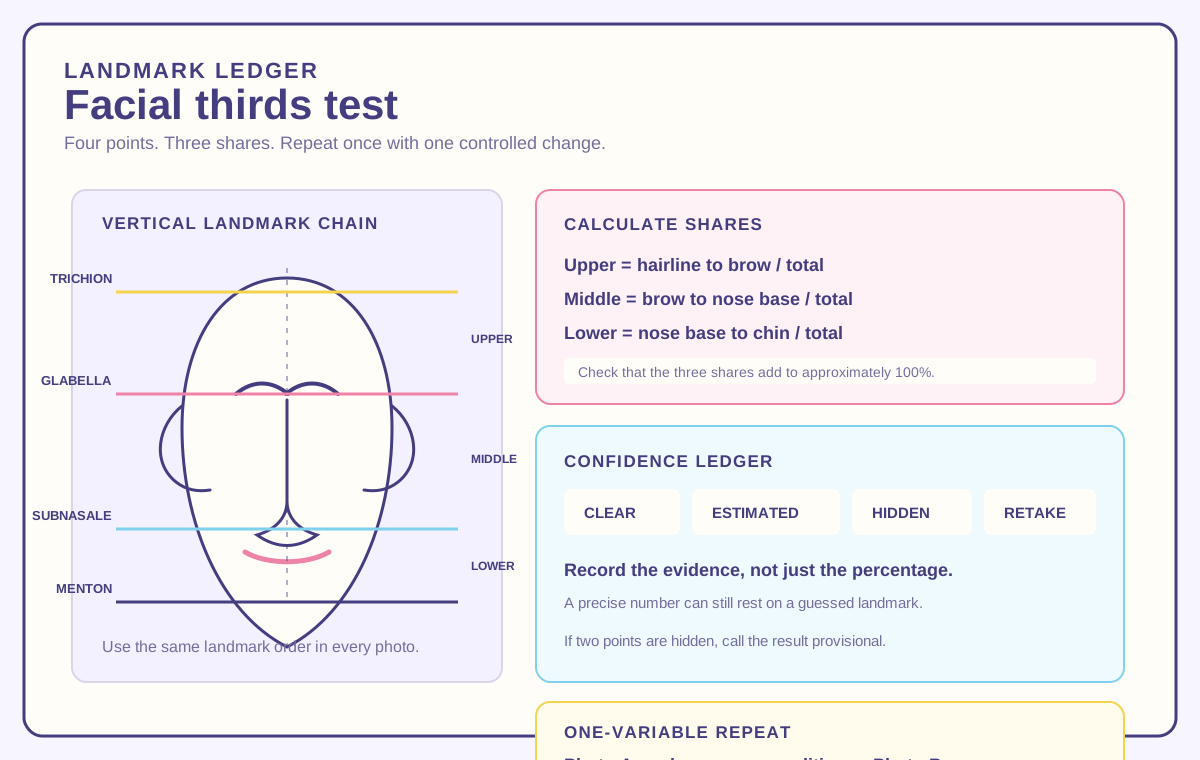
Draw the four marks as horizontal guides across the same portrait. Then draw one vertical reference through the center of the face. The reference does not have to pass perfectly through every feature. Its job is to keep the horizontal lines parallel and the measurement in the same image plane.
Do not move a line to make the sections look more even. The test is supposed to preserve the difference between the points, not hide it.
Calculate each third as a share of total height
Measure each section on the same vertical line. Do not compare facial distances by holding a ruler to the screen without accounting for the image scale. Use the ratio inside one photo.
The formulas are:
```text
Upper third = trichion to glabella / trichion to menton
Middle third = glabella to subnasale / trichion to menton
Lower third = subnasale to menton / trichion to menton
```
As a calculation check, the three shares should add to approximately 100% of the measured total. A small discrepancy is normal when a tool reads pixel coordinates. A large discrepancy means the landmarks or total height were recorded incorrectly.
| Third | Vertical boundary | What the share describes |
|---|---|---|
| Upper | Hairline to brow center | Forehead height within this photo |
| Middle | Brow center to nose base | Vertical space from brow to the base of the nose |
| Lower | Nose base to chin | Vertical space through the lower face |
Record the raw landmark positions or the measured distances when the tool exposes them. A percentage without its landmarks is difficult to audit, especially when the hairline is the least certain point.
Keep an uncertainty ledger beside the result
The most useful part of a facial thirds test is not a single balance number. It is a record of which points were clear and which were inferred. Use five columns:
| Landmark | Confidence | Evidence in the photo | Alternate possible line | Effect on the result |
|---|---|---|---|---|
| Trichion | Clear / estimated / hidden | Visible edge, fringe, hat, or crop | A second plausible hairline position | Which third changes if the line moves |
| Glabella | Clear / estimated / hidden | Soft center between relaxed brows | Brow top or nasion-based position | Middle and upper boundary |
| Subnasale | Clear / estimated / hidden | Nose-base and upper-lip junction | Nose tip or upper-lip edge | Middle and lower boundary |
| Menton | Clear / estimated / hidden | Lowest chin point in frame | Beard line, shadow, or jaw angle | Total height and lower share |
This ledger prevents a common error: treating every decimal in a calculator as equally trustworthy. A tool may use precise pixel coordinates while placing the hairline from an image where the hairline cannot actually be seen. Precision in the output does not remove uncertainty in the input.
Use clear only when you can point to the visible landmark. Use estimated when you can identify a narrow plausible range. Use hidden when hair, cropping, shadow, or image quality makes the line speculative. If two landmarks are hidden, label the entire measurement provisional.
Interpret the pattern without turning it into a score
After calculating the three shares, name the longest section, the shortest section, and the size of the difference between them. That description is more useful than awarding an unexplained "balance" score.
| Pattern | What the measurement supports | What it does not support |
|---|---|---|
| Upper share is longest | The hairline-to-brow span occupies the largest part of the measured total in this photo | That the forehead is a flaw or that it needs correction |
| Middle share is longest | The brow-to-nose-base span is the largest measured section | That the nose has a particular shape or needs treatment |
| Lower share is longest | The nose-base-to-chin span is the largest measured section | A claim about the jaw, bite, character, or attractiveness |
| Shares are close | The four selected landmarks divide this image fairly evenly | Proof of health, symmetry, or a universal beauty standard |
The classical equal-thirds rule belongs to an artistic and clinical reference tradition. It is not a rule that every normal face follows. Published anthropometric work has repeatedly found that real faces, including faces judged to be attractive, do not consistently match the classical canons. A result that differs from equal sections is therefore a description of variation, not evidence of a defect.
Also keep facial thirds separate from:
- face shape, which compares several widths, length, and contour turns;
- symmetry, which compares paired features on the left and right;
- color analysis, which evaluates how color behaves beside the face;
- identity or health, which cannot be established from a proportion test.
Run a second pass with one controlled change
One calculation is a hypothesis about an image. Two controlled passes are a test of repeatability. Keep the same person, camera, expression, and source image, but change one condition at a time.
- Reveal the hairline more clearly. Pull all hair away, take a new photo at the same height, and move only the upper landmark if the newly visible edge changes.
- Level the head. Compare a level frame with a frame where the chin is lifted or tucked. If the lower share changes while the other landmarks remain visible, record a pose effect.
- Change camera distance, not angle. Move the camera farther away and zoom or crop to the same face size. A close lens can make the nose and center of the face appear larger, which may shift how the brow and nose-base line are read.
- Relax the expression. Unclench the jaw, close the lips without pressing them, and look straight at the lens. Do not compare a forced smile or raised brow with a neutral frame.
Place the two results in one of four states:
- Repeatable: the same landmark order and the same longest and shortest sections survive the clean retake.
- Photo-sensitive: the result changes when head level, distance, crop, or lighting changes.
- Landmark unresolved: the hairline, nose base, or chin cannot be identified reliably enough for two defensible placements.
- Outside this test: pain, swelling, a changing bite, vision changes, or a sudden facial movement difference needs an appropriate professional assessment rather than another cosmetic measurement.
The state belongs to the comparison, not to the person. A photo-sensitive result does not mean that the first image was dishonest. It means the two images produced different evidence.
Use the result as a proportion note
A useful final note sounds like this: "In photo A, the lower section was the longest; the middle section was the shortest; the hairline was clear and the chin was clear; the pattern remained in photo B after the camera moved farther away." That sentence can be checked.
A weak final note sounds like this: "My facial thirds score proves that my face is unbalanced." It hides the landmarks, the image conditions, and the difference between a reference convention and a personal flaw.
For another geometry check, use the [face shape detector](/face-shape-detector) and the [face shape chart](/face-shape-chart). The detector compares length and width ratios, while this test follows a vertical landmark chain. To inspect left-right paired features separately, use the [face symmetry test](/face-symmetry-test). To compare color behavior instead of spatial proportions, continue with the [color analysis quiz](/color-analysis-quiz).
Facial thirds test questions
What counts as a normal facial thirds result?
There is no universal normal result that applies to every face and population. The equal-thirds convention is a reference, not a health threshold. A useful test reports the three shares, the landmark confidence, and whether the pattern repeats.
Why does the hairline make the upper third uncertain?
Hairlines vary naturally and can be hidden by fringe, styling, cropping, lighting, or recession. A landmark model may not have an explicit hairline point, which is why some automated tests omit or estimate the upper third. Mark that uncertainty instead of treating the estimated line as exact.
Should I use the eyebrow line or the brow bone?
Use one clearly defined position consistently. Many manual methods use the glabella, the soft center between the brows. A test that uses a nasion or brow-top reference may produce different numbers. Compare results only when the landmark definitions match.
Why do two facial thirds calculators disagree?
They may use different landmarks, image crops, perspective correction, or formulas. One tool may measure middle and lower thirds only, while another estimates the hairline. A percentage is not portable between tests unless both use the same four boundaries and the same total face height.
Does equal thirds mean a face is more attractive?
No. A proportion convention cannot establish attractiveness on its own. Facial impressions also involve movement, skin, hair, expression, symmetry, color, culture, and personal preference. Do not use this test to rank yourself or another person.
Can facial exercises change the measured thirds?
This test measures vertical landmark positions in a photo. It does not establish that exercises change skeletal proportions. Keep marketing claims separate from the evidence you can actually observe, and do not treat an online proportion result as medical advice.
The best facial thirds test gives you a reproducible landmark ledger, not a dramatic label. Keep the four boundaries visible, record confidence, and compare two controlled photos before deciding that a pattern is stable.